

Separate the argument from the way it is being presented.
Think Critically. Think Clearly.
Because there’s more to every story.
Understand what you’re reading. Think for yourself. Critical Analysis helps you examine the reasoning behind news articles, social media posts, opinion pieces, screenshots, and more. See what evidence supports the message, spot potential biases and persuasive language, and understand how it might shape your thinking.
Start with 3 free analyses every week.
What you get
A sharper second look.
Surface framing, certainty, social pressure, bias, and persuasive technique.
Use the analysis as input. Keep the final decision yours.
How it works
Paste. Choose. Read.
We give you another perspective to consider. You make the more informed judgment of your own.
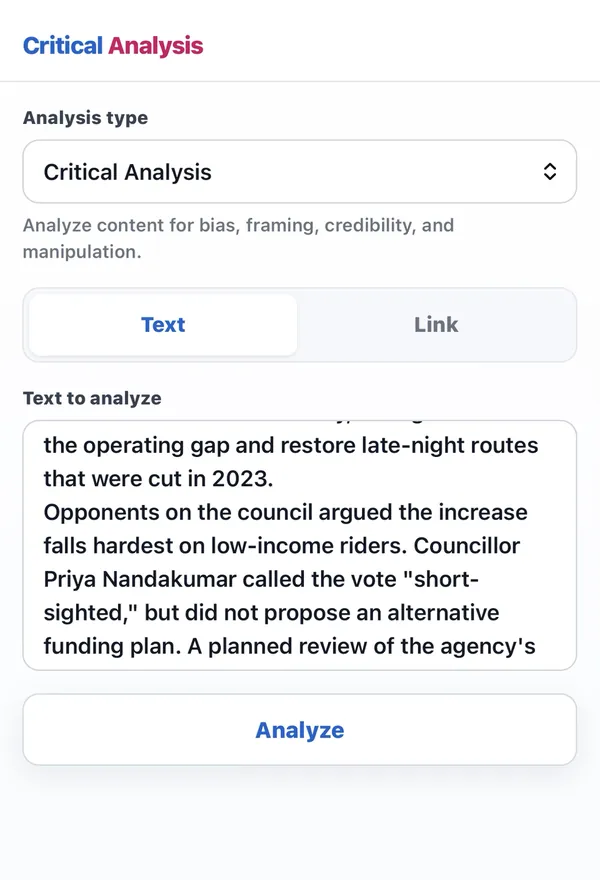
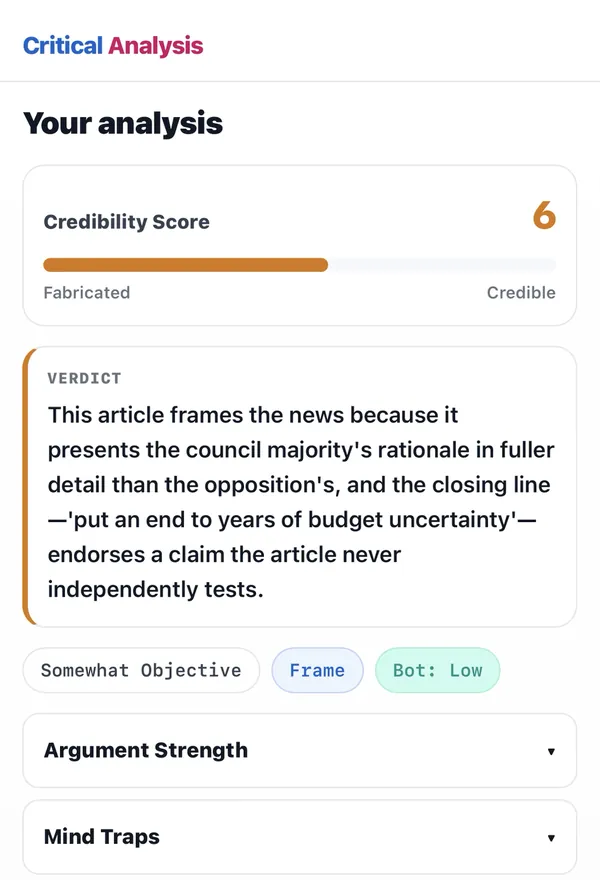
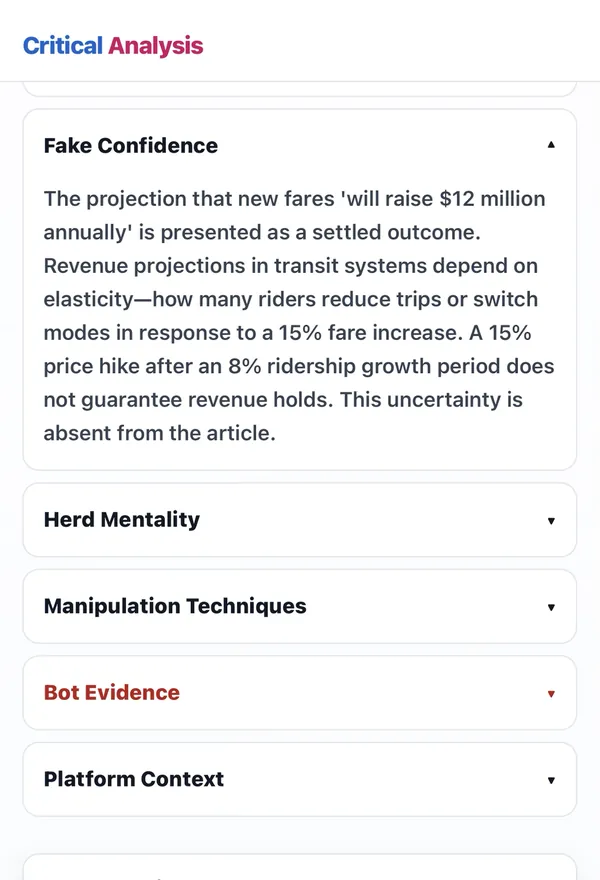
A sample analysis of a fictional news article, run in me.app.
Four analysis types
Critical AnalysisAnalyze content for bias, framing, credibility, and manipulation.
- Best for
- News articles, opinion pieces, social media posts, and screenshots.
- You get
- A Credibility Score from 1 to 10, an agenda level from Report to Fabricate, a verdict, and findings on argument strength, mind traps, fake confidence, herd mentality, manipulation techniques, and bot evidence.
Business & Financial MediaAnalyze financial news, analyst commentary, and market framing.
- Best for
- Coverage of companies, markets, and earnings, plus analyst commentary and investor communications.
- You get
- The same score, verdict, and findings as Critical Analysis, with attention to whether the framing is promotional, bearish, defensive, agenda-driven, or neutral, and extra scrutiny of confident claims about unknowable outcomes such as forecasts and price targets.
Wikipedia AnalysisReview encyclopedia claims, sources, due weight, neutrality, and omissions.
- Best for
- The text of a Wikipedia article.
- You get
- A score, a verdict, and findings on which claims are supported, how neutral and balanced the framing is, and what the article leaves out.
- Good to know
- It analyzes the article text you provide, not its edit history or talk pages.
Informational AnalysisRigorous, structured, neutral understanding of a person, organization, place, event, work, or other identifiable subject — not a bias or influence assessment.
- Best for
- Getting up to speed on a person, organization, place, event, book, film, or other subject.
- You get
- A neutral verdict and summary, subject identification, and key facts that adapt to the kind of subject.
- Good to know
- There is no score, because it does not assess bias.
What’s behind each result
What is being analyzed?
The content you submit: an article, a post, pasted text, or a screenshot. We analyze how it is built — its claims, sourcing, framing, and language. It is not a fact-check.
Which framework is used?
Each analysis type uses its own proprietary framework, built on established research in logic, behavioral science, and economics. The four types above show what each one examines.
How are findings generated, categorized, and scored?
Our AI reads the content against the framework and writes findings in sections such as Argument Strength, Mind Traps, and Fake Confidence. Critical Analysis also gives a Credibility Score from 1 to 10 (Fabricated to Credible) and an agenda level from Report to Fabricate. The findings themselves are written explanations, not scores.
How do we separate evidence from interpretation?
We look at what a piece offers as support — named, checkable sources versus unsupported claims — and report that separately from how it is framed and worded. What you see is analysis: a perspective to weigh, not a verdict. AI can make mistakes, so check anything that matters.
Examples of what a finding looks like
| Category | Example finding | What it means |
|---|---|---|
| Argument strength | Partly supported | Some evidence supports the claim, but important parts remain unsubstantiated. |
| Use of evidence | Selective evidence | The argument emphasizes some evidence while leaving other relevant evidence unaddressed. |
| Cognitive bias | Framing effect | The presentation may influence how the reader interprets the same underlying information. |
| Persuasive technique | Overstated certainty | The wording expresses greater confidence than the evidence appears to justify. |
| Persuasive technique | Missing context | Relevant information appears absent from the material being analyzed. |
Examples are illustrative. Findings are written for each piece of content and will vary.
The promise
Informed. Not Influenced.
Critical Analysis is designed to help you examine the message before accepting the frame.
Pricing
Simple pricing.
Free: 3 analyses every week · Credit packs: 5 for $5 · 25 for $9.99 · 75 for $25 · Subscriptions: $15/month or $110/year, 50 analyses/month, no rollover · USD
Create one account, then use Critical Analysis in me.app or the Chrome extension. See your signed-in account for currently available purchase options.
Choose how you use Critical Analysis.
Start with 3 free analyses every week, then analyze in me.app or directly in Chrome.